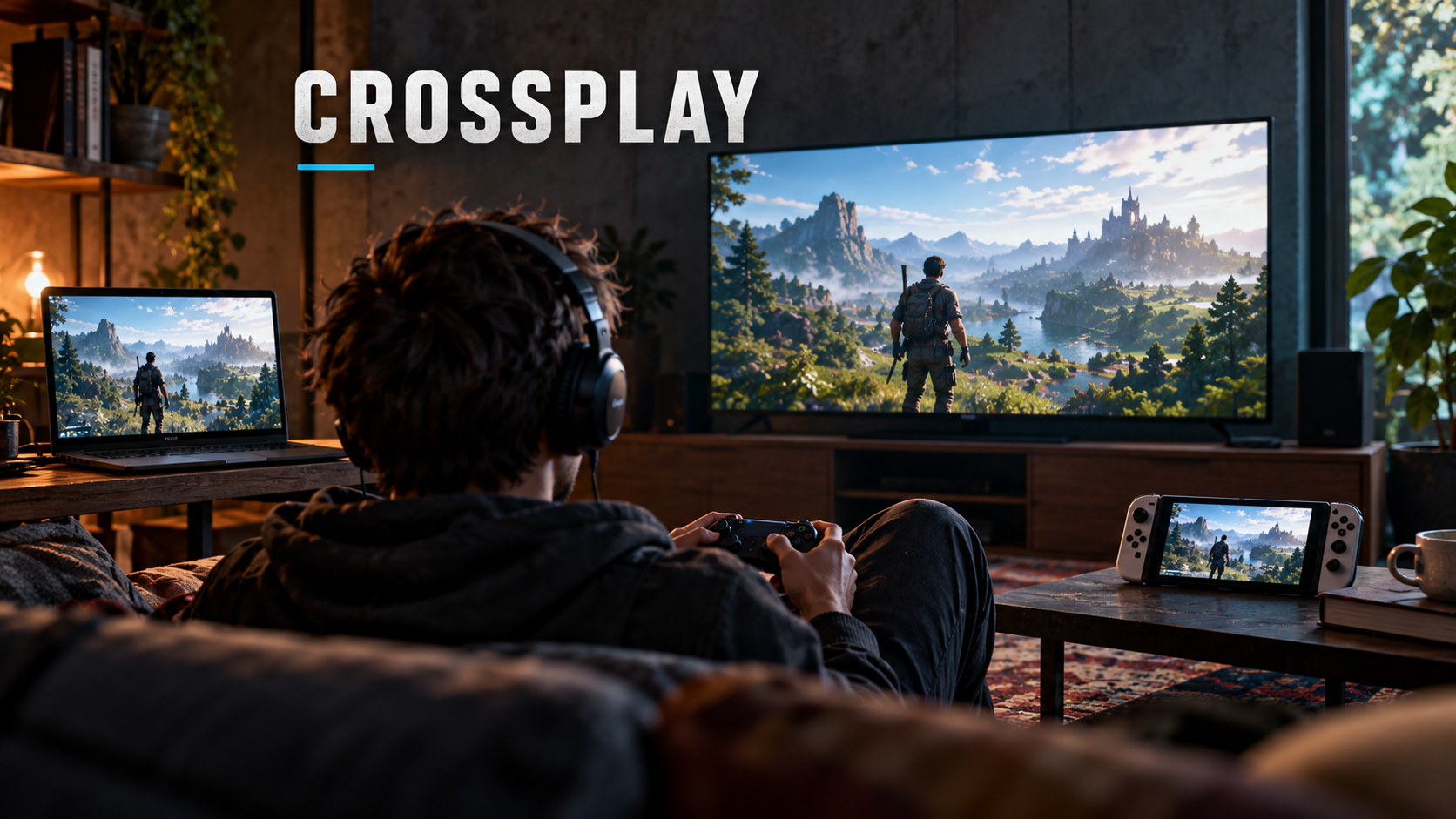
THE RISE OF CROSSPLAY GAMING
The History, Technology and Infrastructure Behind Cross-Play
By Jamieson Lee Hill, Video Game Storywriter and Resident Blogger
Summary
- What Is Cross-Platform Gaming?
- The History of Cross-Platform Gaming: 1998–2026
- Seven Barriers to Crossplay Adoption
- AAA Games Supporting Crossplay in 2026
- Indie Games Supporting Crossplay in 2026
- Why AAA Publishers Favour Crossplay
- Crossplay vs Cross-Progression
- How IP House Colocation Supports Cross-Platform Gaming
- Conclusion
Key Takeaways
- Cross-platform gaming: Crossplay allows players using different devices, including PlayStation, Xbox and PC, to play together in supported multiplayer games.
- History and evolution: Crossplay developed from early experiments in the late 1990s into a mainstream feature of modern multiplayer gaming.
- Seven barriers to adoption: Commercial resistance, competing console networks, hardware differences, security concerns, competitive fairness and development costs delayed widespread adoption.
- AAA and indie gaming: Major publishers and independent studios increasingly use crossplay to connect players, expand gaming communities and extend game lifespans.
- Technology and infrastructure: Crossplay depends on account synchronisation, cloud saves, authentication, real-time data transfer, security and scalable infrastructure.
- IP House colocation: IP House's London Docklands data centre provides a professional hosting environment for gaming studios managing their own servers, networking equipment and supporting infrastructure.
Introduction
Cross-platform gaming, also known as crossplay, has transformed the gaming industry by allowing players to play together online across different consoles and devices including PlayStation, Xbox, mobile and PC (and earlier devices). Players now have the freedom to compete and cooperate in the same online games, rather than being stuck in their console or device manufacturer’s ecosystem.
This evolution has taken nearly three decades, overcoming technological challenges, commercial resistance and competition between console manufacturers.
Today, crossplay is a major feature in many AAA and indie multiplayer games, helping studios expand their gaming communities, improve matchmaking and extend the lifespan of their titles.
In this article, we explore the history of cross-platform gaming from its earliest experiments in the late 1990s to 2026, the seven barriers that delayed its adoption and the games leading its development today.
We also examine the technology and infrastructure behind crossplay, and how IP House London's colocation services can support gaming studios as their multiplayer communities grow.
Cross-Play Explained
Cross-platform play (crossplay) is now mainstream in a number of AAA games and also Indie titles. These include multiplayer shooters, sports games, racing games and live-service titles. We will delve into those specific games a little later on.
Cross-play allows gamers to play games together online on different consoles and devices such as PlayStation 5, Xbox Series X/S and PC. The advent of the cloud and cloud gaming has opened up the evolution of cross-platform play.
The cross-play feature is considerably more common in multiplayer-focused games than in traditional single-player releases.
The History of Cross-Platform Gaming: 1998–2026
I always love a good dive into technology history whether it be gaming, education or financial technology. It gives a clearer context to where we are now and where we have come from.
You may be surprised to know that crossplay stretches back nearly three decades. It all kicked off in early Sega Dreamcast experiments in the late 1990s, and then expanded through Final Fantasy XI and Shadowrun.
It became mainstream in gaming following Fortnite and Sony's policy changes in 2018–2019. Its evolution reflects advances in technology, changing commercial strategies and growing consumer demand.
1998–2001: Early Crossplay Experiments
Sega's Dreamcast, launched in Japan in 1998, was the console that helped establish the foundations of cross-platform gaming. Personally, I was a Sega Megadrive gamer in the 90s and also had a Nintendo 64. By the late 90s I made the step towards becoming a PC gamer for the next 3 decades.
The Dreamcast had a built-in modem which supported internet connectivity. Games including 4x4 Evolution explored multiplayer connections between console and PC players.
In the early days of crossplay, the scope was limited due to slow internet connections, incompatible systems and restrictions to online services. However, jump forward to September 2001 and the game Capcom vs SNK2 allowed PS2 and Japanese Dreamcast console owners to play online together.
This was a major milestone in showing that multiplayer gaming could connect competing consoles instead of players being in separate hardware ecosystems.
2002–2006: Final Fantasy XI Expands Crossplay
The company Square Enix advanced crossplay in 2002 with the classic game Final Fantasy XI. They connected PlayStation 2 and Windows PC players within the same world. Then in 2006, Xbox 360 followed suit, expanding its multiplayer community.
Final Fantasy XI was a moment in gaming history as it clearly proved that crossplay could sustain large online gaming communities.
Nevertheless, the console brands continued with their separate networks and resisted change as they did not want to open up their ecosystem to the competition.
2007–2010: Microsoft Experiments With Crossplay
Microsoft's Shadowrun connected Xbox 360 and Windows Vista players in 2007 through Games for Windows Live. It was one of the first First Person Shooters to be crossplay.
It still has a retro following community that still enjoys it today. The game highlighted the difficulties in competitive balance problems between keyboard-and-mouse users and console players using controllers, but was largely a technical success.
Developers had to adjust aiming mechanics to make sure it was fair between PC And XBox 360. These technical challenges, along with network incompatibility, and console manufacturer restrictions, slowed down the quest for widespread crossplay adoption across the globe. Shadowrun was a forerunner of crossplay but sadly the studio shut down.
2011–2015: Crossplay Gains Momentum
Jump forward to 2011, Valve's Portal 2 connected PlayStation 3 and PC players. Portal 2 was a first person puzzle platformer rather than using traditional combat weapons.
Two years later in 2013, Windows and PS3 had shared multiplayer action with Final Fantasy XIV: A Realm Reborn.
At that time, the improvements in broadband connectivity and networking technology made crossplay increasingly practical and workable.
Nevertheless, some console manufacturers still controlled access to their online services which meant games released as multiplayer could not always connect across platforms.
2016–2017: Microsoft Finally Opens Its Network
In March 2016, Microsoft finally announced plans to connect Xbox Live with other gaming networks.
Following this, the iconic Rocket League became multiplayer with XBox One and PC. Nintendo also told their community in 2017 that crossplay support would come for Minecraft and Rocket League. You could play one, two, three or four players. It was very popular and still has a following today.
This was a pivotal move as Microsoft's decision challenged the commercial advantages of keeping players within separate console ecosystems which had previously held crossplay back from being widely adopted.
2017–2018: Fortnite Transforms Crossplay
In the years 2017 and 2018, there was a major shift with Sony adopting crossplay. This pivotal moment laid the foundations for widely adopted crossplay that we see today in 2026.
Interestingly, gamers on Fortnite were briefly connected between PS4 and XBOX One in September 2017. This was due to a configuration error and was not intentional. However, this chance occurrence proved that cross-console multiplayer was technically achievable.
As Fortnite expanded in 2018, growing consumer demand increased pressure on Sony to remove crossplay restrictions. In September 2018, Sony relented and introduced a crossplay beta, finally accepting that, "Cross-platform experiences add significant value to players." Source: Kodera (2018), PlayStation Blog.
This event was a major shift towards connected gaming communities via crossplay.
2019: Sony Expands Crossplay Support
Sony's policy change in 2018 led to wider adoption of cross-platform gaming. In January 2019, Rocket League expanded crossplay across major platforms, followed by the online RPG hit game Dauntless later that year. Destructoid described it as ‘A Beacon for Crossplay’ when it hit its 6 million gamer milestone. (Dauntless had more than 30 million total players by its anniversary in 2022, but sadly it closed its servers on May 29th, 2025.)
By October 2019, Sony had moved beyond its initial crossplay beta and made the technology more widely available to developers. This took away a big barrier to crossplay adoption, but there were still issues with development costs, network integration and security.
2020–2023: Crossplay Becomes Mainstream
Moving into the Era of the 2020s, AAA games adopted crossplay as a mainstream multiplayer feature. Titles including
Call of Duty: Warzone,
Apex Legends,
Minecraft and
Fortnite all started offering cross-platform gaming.
Also, Epic Games introduced Epic Online Services in 2020, providing developers with cross-platform matchmaking and account management tools. Cross-progression also gained importance i.e. the ability for players to transfer their in-game progress between devices.
The legendary
Diablo IV demonstrated how combining both features could improve the multiplayer experience. Diablo IV (2023) is a dark fantasy action RPG developed by Blizzard Entertainment and is the epitome of how crossplay and cross-progression can connect players across PC, PlayStation and Xbox.
2024–2026: Crossplay Becomes an AAA Expectation
In this 2 year period, crossplay became a common expectation in AAA multiplayer gaming. The benefits were clear for the AAA studios: crossplay extended game lifespans, improved matchmaking and increased online player communities.
In 2024, the highly popular Helldivers 2 demonstrated the growing importance of crossplay between PlayStation 5 and PC, while Call of Duty: Black Ops 6 supported multiplayer across Xbox, PlayStation and PC.
In 2025, Monster Hunter Wilds and Battlefield 6 expanded crossplay across major platforms. By 2026, EA Sports FC 26 reflected its continued adoption in sports gaming.
By 2026, crossplay was common across major multiplayer genres and EA Sports FC 26, Battlefield 6, Monster Hunter Wilds and Forza Horizon 5 demonstrated the adoption of crossplay across sports, shooters, action RPGs and racing.
Despite the many advantages of cross-platform gaming, crossplay still has negative obstacles to overcome including:
- competitive fairness
- security
- hardware differences
- infrastructure requirements
Seven Barriers to Cross-Play: Why Did Cross-Play Take So Long?
Cross-play took nearly 30 years to become mainstream because the biggest obstacles were not just technological. Personally. I had wondered for years why it hadn't happened sooner, but I was oblivious to the fact that many console brands were resisting the adoption of crossplay to protect their ecosystem revenue and exclusivity. It just seemed illogical why different gaming devices couldn’t link up online.
There were commercial, competitive and political factors within the gaming industry that delayed crossplay for so many years. The resistance of the console manufacturers meant it was a slow process.
Let’s summarise the seven main barriers here:
1. Console manufacturers resisted cooperation. Sony, Microsoft and Nintendo operated competing gaming ecosystems. For years, they didn’t want players to connect across platforms because they felt it weakened the exclusivity that helped attract customers to their consoles and it would open up their customer base to the competition.
2. Companies wanted to protect their revenue. Console manufacturers benefited from keeping players, their friends and their purchases within one ecosystem to maximise their revenue. For a long time, console manufacturers believed that crossplay potentially reduced that commercial advantage. However, in 2026, console manufacturers realise the extra revenues and longevity of the game that cross-platform gaming can bring.
3. Different hardware created technical problems. PCs, consoles and mobile devices had different processing capabilities, operating systems, network architectures and performance limitations. This meant that developers needed to make multiplayer experiences work reliably across them to avoid some gamers having an advantage over others.
4. Separate online networks were difficult to connect. Xbox Live, PlayStation Network and Nintendo's online services developed independently. To be able to connect players for online gaming meant compatible authentication, matchmaking, account management and communication systems. There wasn’t the will or the technical linkup for years.
5. Security and moderation were major concerns. Cross-play introduced complications involving cheating, account security, parental controls, player reporting and enforcement across different platforms. Thus, console manufacturers preferred to manage their own security, compliance and cheating prevention in-house rather than collaborating with other companies.
6. PC players sometimes had competitive advantages. Keyboard and mouse controls could give players an advantage over controllers, particularly in first-person shooters. Different frame rates and performance levels could also affect competitive balance i.e. a slow FPS meant the player could fire less rounds in combat.
7. Cross-play required additional investment. As with any new technology, developers needed to build, test, maintain and support cross-platform systems. For smaller studios this was out of reach due to smaller budgets, less technical resources and infrastructure incapable of crossplay.
AAA Games Supporting Crossplay in 2026
As we have already seen, crossplay is an expected mainstream feature in many AAA games nowadays. Let’s have a look at some of the leading titles using it.
How widespread is cross platform gaming in AAA games?
There isn't a reliable industry-wide percentage of AAA releases supporting crossplay, because definitions and game categories vary.
However, the industry trend is clear:
- Competitive shooters: Crossplay is a standard expectation.
- Sports games: Increasingly common, although some modes and console generations remain separated.
- Racing games: Common in major online franchises.
- Cooperative RPGs: Increasingly common.
- Single-player AAA games: Generally irrelevant unless they include multiplayer.
Sports and racing games
EA Sports’ iconic series continues with FC 27 supporting crossplay between PS5, Xbox Series X/S and PC. EA confirms crossplay groups for:
- PS5, Xbox Series X/S and PC.
- PS4 and Xbox One in a separate generation.
I have played FC (and the old FIFA series since 1993), but personally since Ultimate Team became ‘pay-to-win’, I just stick to Career Mode. Old skool gaming ethics.
The American football classic Madden NFL 26 connects players across PS5, Xbox Series X/S and PC. If racing and sportscars are your thing, Forza Horizon 5 supports crossplay between PS5, Xbox and PC, allowing players on different systems to share its open-world racing experience.
Competitive shooters and battle royale
The epic Battlefield franchise is in its sixth incarnation with Battlefield 6. It also supports crossplay between PS5, Xbox Series X/S and PC.
Likewise, Call of Duty: Warzone connects players across PlayStation, Xbox and PC, making it easier for friends with different hardware to form a squad. (I was a big fan of Call of Duty for years but as I get older, I prefer retro classics like Rome Total War Remastered.)
One of the early forerunners of crossplay, Fortnite, offers broader platform coverage, supporting crossplay across PlayStation, Xbox, PC, Nintendo Switch and supported mobile devices.
Apex Legends is a free-to-play Battle Royale online game. It also connects players across PlayStation, Xbox, PC and Nintendo Switch. This 2019 shooter was developed by Respawn Entertainment and published by Electronic Arts. It is set in the same universe as the Titanfall series.
Cooperative action and role-playing games
My ex-Game Design colleague was a huge fan of the Diablo franchise. I have never played it myself but the games look incredible. Diablo IV supports crossplay across PlayStation, Xbox and PC. Players can team up across these platforms to explore the world, fight enemies and complete cooperative activities.
Monster Hunter Wilds connects players on PS5, Xbox Series X/S and PC, allowing friends to join hunts without owning the same gaming system. Helldivers 2 is on my list of games to play. It too supports the same platform combination, bringing players together for cooperative missions.
Fighting games
The classic Street Fighter franchise has its 6th version as a crossplay experience between PlayStation, Xbox and PC.
I remember the heady days of the first street fighter in arcades from 1987. With coins in hand and a bag of chips, we would play in our local arcade in Worcester.
Street Fighter 6 has come a long way since then and it now allows players on different systems to compete against one another, extending multiplayer access beyond the community using their own hardware.
Creative and survival games
Minecraft’s Bedrock Edition supports crossplay across PlayStation, Xbox, Nintendo Switch, Windows PC and mobile devices. Friends can build, explore and survive together while using different systems. Please note: the Java Edition does not support native crossplay with Bedrock Edition.
I never really felt the pull of Minecraft, but I have an adult son who still loves it to this day. I was always getting stuck down holes.
Why do AAA publishers favour crossplay?
Crossplay offers significant commercial advantages.
Larger player populations: Faster matchmaking and healthier multiplayer communities is a big plus.
Longer game lifespans: Players remain engaged even when one platform's population declines. This makes sense that if the game is on multiple platforms, it has a greater chance of a longer lifespan. Retro gaming communities are thriving.
Higher potential revenue: Larger connected communities support ongoing sales and live-service monetisation. This is the reverse thinking of what console manufacturers thought in the past and one of the reasons they resisted crossplay for so many years.
Reduced fragmentation: Friends can play together without owning identical hardware. This is something I always wanted for FIFA before the crossplay feature existed as my friends had consoles and I was a PC Gamer from 1999.
Indie games supporting crossplay in 2026
Crossplay is also firmly embedded in the Indie game sector with the following titles including it as a feature.
Among Us: Social deduction
Among Us is an indie game I covered in a previous article. I actually downloaded the game for research and played it for a short time. Very surreal! It is a highly popular party multiplayer game that supports crossplay across PC, Android, iOS, PlayStation, Xbox and Nintendo Switch.
Players work together to complete tasks while trying to identify the impostors hiding among their crew.
No Man’s Sky: Space exploration
No Man’s Sky, the action adventure survival game from Hello Games, also has a crossplay feature between PC/Mac, PS4/PS5, Xbox One/Series X/S and Nintendo Switch 2. Players can explore planets, build bases and undertake multiplayer activities together across these systems.
Phasmophobia: Cooperative ghost hunting
Phasmophobia , the 2020 paranormal horror game, by British indie game studio Kinetic Games, is another indie title to feature cross-platform gaming. It connects players across PC, PS5, PSVR2 and Xbox Series X/S.
Teams investigate haunted locations, gather evidence and identify the ghost they encounter. Its optional crossplay feature allows friends using different platforms to investigate together.
Valheim: Viking survival
Next up, we have Valheim, the collaborative and exploration survival game for 1 to 10 players. This is definitely on my wish list although I am not the world’s most eager survival genre type. Solely for the Viking lore. The studio confirmed in June 7th, 2026 that the game would be released on September 9th, 2026 and,
“The release will hit PC, Linux, Mac, Xbox One and Xbox Series X|S as per usual, and now we’re also adding PlayStation 5 and Nintendo Switch 2 to the roster. Of course there will be full crossplay between all the platforms, so that you can play with your friends.”
Source: Valheim, June 7th, 2026
Players share a survival world, gather resources, construct settlements and face enemies together.
Overcooked! All You Can Eat: Cooperative cooking
Overcooked! All You Can Eat is a ‘chaotic cooking game’ where players work together or alone to serve as many dishes as possible before time runs out. It supports crossplay between PC, PS4/PS5, Xbox One/Series X/S and Nintendo Switch.
Players coordinate food preparation, cooking and serving while navigating increasingly chaotic kitchens. Everyone must use the All You Can Eat edition to access this shared crossplay experience.
Moving Out 2: Cooperative removals
Moving Out 2 is a co-operative sim, removals game. You can crossplay across PC, PS4/PS5, Xbox One/Series X/S and Nintendo Switch. Up to four players can work together online to move furniture through unusual locations and overcome obstacles.
Epic Games’ Crossplay Feature for Indie Developers
One cool development by Epic Games is their feature specifically for indie developers using Epic Online Services for cross-platform capability and live multiplayer systems.
If you are an Indie Studio, it could be very useful because it connects your technical subject directly to your audience via your hosting and servers. It's part of Epic's EOS resources. You can read Epic’s Indie Case Studies here.
Crossplay is a Given in 2026 for AAA Multi-player Games
The bottom line is that by 2026, crossplay has shifted from a premium feature to an expected capability in major multiplayer AAA games. For a new AAA multiplayer title, launching without crossplay can now be a competitive disadvantage.
Ironic when you consider all the resistance to crossplay in the past due to a fear of losing revenues and share of the market. Now the world has been turned upside down with crossplay as an opportunity for increased revenues over a longer period of time.
Crossplay Does Not Always Equal Cross-progression
One important distinction to make is that crossplay does not automatically mean cross-progression. Players may be able to compete together across platforms but that doesn’t mean that they can transfer purchases, characters or saved progress i.e. cross progression.
Of course, in the passage of time, more and more studios will offer crossplay and cross-progression in tandem.
How Do IP House Colocation Services Support Cross-Platform Gaming?
IP House London is a data centre in the Docklands in London that supports gaming studios, whether they be indie studios or AAAs. IP House helps support cross-platform gaming in the following ways:
- Account Synchronisation
- Cloud Saves and Cross-Progression
- Authentication Systems
- Real-Time Data Transfer
- Infrastructure Challenges
- Security Risks
- Scalability Requirements
Account Synchronisation
Crossplay allows gamers on PlayStation, Xbox and PC to play together, but how do games recognise the same player across different devices?
Account synchronisation links player identities, profiles, friends lists and supported achievements across platforms. For example, Fortnite uses Epic Games accounts to connect players across devices.
IP House colocation in London's Docklands provides a hosting environment for studios managing their own account databases and supporting servers.
Cloud Saves and Cross-Progression
Cloud saves store game progress online, while cross-progression allows supported characters, achievements and inventories to transfer between platforms.
Studios must prevent conflicting saves, data corruption and progress loss. IP House colocation provides a professional data centre environment for hosting storage infrastructure, while studios manage backups and data protection. Read more about Cloud Saves for gaming data here: Unity – Cloud Save Documentation
Authentication Systems
Authentication verifies player identities and controls access to multiplayer services. It also connects platform-specific accounts to central gaming systems.
Major launches can generate thousands of simultaneous login requests. IP House colocation allows studios to host their own authentication servers within a controlled physical environment. You can read more about authentication here: Unity – Authentication Overview
Real-Time Data Transfer
Crossplay requires rapid communication between players and game servers, including movement, combat actions and scores.
Latency, packet loss and unstable connections can cause lag and delayed responses, particularly in competitive games such as Call of Duty: Warzone. This is every gamer’s worst nightmare because lag can mean defeat on the battlefield or pitch.
IP House's London Docklands location enables studios to establish a UK server presence and connect with suitable network providers, supporting their wider connectivity strategy.
Infrastructure Challenges
Crossplay requires reliable matchmaking, databases, game servers and connectivity across different gaming platforms.
Dedicated servers help maintain consistent multiplayer sessions.
IP House colocation allows studios to retain control of their own equipment while using professionally managed data centre facilities.
Security Risks
Cross-platform gaming introduces risks including account theft, cheating, unauthorised access and malicious traffic. Studios need encryption, secure authentication, anti-cheat systems and continuous monitoring.
IP House colocation provides a controlled physical environment for gaming infrastructure, complementing the cybersecurity measures managed by developers.
Scalability Requirements
Successful launches, seasonal events and major updates can generate sudden increases in player demand. Studios need scalable server capacity, load balancing and failover systems to maintain performance.
IP House colocation can accommodate planned server expansion, subject to available capacity and power, helping growing studios develop their infrastructure alongside player demand.
Supporting Your Gaming Community
Whether you're an indie developer, growing studio or AAA publisher, successful crossplay depends on reliable connectivity, secure systems and scalable infrastructure.
IP House provides data centre colocation in London's Docklands, offering gaming businesses a professional environment for hosting and managing their own servers and networking equipment.
Cross-play was technically possible long before 2018. What changed was the industry's willingness to support it across competing console ecosystems.
Cross-play did not take nearly three decades to become mainstream simply because the technology was unavailable. The main barrier to change were the console manufacturers. They were reluctant to open their gaming ecosystems to competitors, partly because they wanted to protect hardware sales, customer loyalty and revenue.
Developers also faced technical challenges involving incompatible networks, player authentication, security, matchmaking and different hardware capabilities.
As online multiplayer gaming expanded, customer demand drove the adoption of crossplay so gamers could compete and cooperate with friends across consoles and devices.
The enormous popularity of Fortnite was a major catalyst for change; it helped accelerate widespread adoption of crossplay when Sony relaxed its restrictions in September 2018.
Planning to launch or expand a cross-platform game? Contact IP House to discuss your colocation requirements. Fill out the Contact Form below.
Technical Review
This article has been reviewed by the IP House Technical Team.
Frequently Asked Questions
What is cross-platform gaming?
Crossplay allows gamers using different devices, including PlayStation, Xbox and PC, to play together online in supported games.
When did cross-platform gaming begin?
Crossplay emerged in the late 1990s, with major milestones including Final Fantasy XI (2002), Shadowrun (2007) and Fortnite (2018).
Why did crossplay take so long?
Console manufacturers resisted cooperation to protect revenue and customers. Hardware differences, security concerns and development costs also delayed adoption.
What is the difference between crossplay and cross-progression?
Crossplay connects players across platforms. Cross-progression allows players to transfer supported game progress, characters and achievements between devices.
How does colocation support cross-platform gaming?
Colocation provides secure facilities for gaming servers and networking equipment. IP House's London Docklands data centre supports studios hosting and scaling their multiplayer infrastructure.
MAIN SOURCES
- I Saw the PlayStation 3 Wired to Play Against an Xbox 360, but You Won’t
- https://www.youtube.com/watch?v=tahx-khTm9M&t=11s
- Fortnite cross-platform progression
- Rocket League cross-platform progression
- Minecraft cross-platform account requirements
- Shadowrun (2007) is Still Playable and It's a Blast!
- Wikipedia: Cross-platform play
- (2025) 'History of cross-platform gaming: How do games combine different platforms?'
- Epic Online Services — Cross-platform services
- Unity — Authentication approaches
- Unity Cloud Save
- AWS Game Backend & Infrastructure
- AWS Hyper-scale Online Games
- Kodera, J. (2018) 'Extended Fortnite cross-play beta launches on PlayStation 4'. PlayStation Blog, 26 September.
- Orland, K. (2016a) 'Why Microsoft is finally pushing for cross-platform online gaming'. Ars Technica, 14 March. Available at:
- Sony PlayStation: Cross-Play Policy Change 2018
- Microsoft Xbox: Cross-Network Gaming Strategy (2016)
- How do I cross-play in EA SPORTS FC™?
- Valheim 1.0 Official Release Announcement
About the Author
Jamieson Lee Hill has been IP House’s resident blogger since 2022, writing about data centre colocation across its core Gaming, EdTech and FinTech sectors. While not a data centre technician, his role is to research complex colocation and digital infrastructure topics and explain them clearly to non-technical readers.
A certified college lecturer and teacher with 27 years of experience, Jamieson holds a DMS in Business Management, Certificate in Education and Cambridge DELTA, alongside 11 DigitalMarketer certifications, including SEO. He also undertakes professional development in cybersecurity, workplace AI, EEAT, AIO and AEO, and has certifications in video game design and storywriting.
Jamieson has run UK limited companies since 2012 and he has written educational books for RET International and Ixion College, including a 600+ page Diploma course book. He has also been editor for 3 books: The Adventures of Tom Sharpe books 1 and 2 by Peter Drinkwater and Life’s A Game by Mev Dinc.
A former teacher trainer and curriculum manager, he has designed courses for organisations including Sainsbury’s, Poundland, Swissport, Staffline and UK colleges. Since 2017, he has also taught and developed curricula for
More Than English Summer School in Business Studies, Global Leadership, Creative Writing and University Preparation.
Contact Us