UNDERSTAND SLEEP TO ACHIEVE YOUR PEAK
How Chronotypes Shape Your Sleep Schedule
By Jamieson Lee Hill, Resident B2B Technology Writer
Summary
- Introduction
Part One: Chronotypes & Chronoworking
- What Are Chronotypes?
- What is your Circadian Rhythm?
- What Are the Four Chronotypes?
- What is Chronolongevity?
- Free Chronotype Quizzes to Try Yourself
- What is Chronoworking?
- How Can You Try Chronoworking?
Part Two: Stephanie Romiszewski
- Can your Chronotype Change?
- Build a Consistent Sleep Baseline
- Why the Morning Matters
- Sleep Trackers, Lie-ins and Catch-up Sleep
- Five Ways to Improve Your Sleep
Introduction
Since the pandemic, work schedules have shifted, with hybrid and remote work becoming popular. Historically, the standard 9-to-5 workday was designed for 20th-century assembly lines, not the demands of modern schedules.
In this article, in Part One, we explore chronotypes, the optimal times for you to work and manage your schedule and chronoworking, aligning your work schedule with your chronotype. The experts mentioned in Part One are Charles F. Ehret, Dr Michael Breus and journalist Ellen C. Scott.
In Part Two, we investigate Stephanie Romiszewski's new book ‘Think Less, Sleep More’ and how to achieve a consistent baseline of sleep. This book suggests that chronotypes are not fixed and can be changed.
Your chronotype influences when you feel most alert, but you may still be able to shift your sleep schedule. Dr Michael Breus suggests planning your day around your natural timing. Stephanie Romiszewski starts with a steadier sleep routine to see how much that timing can change.
I tend to go to bed late and not sleep more than 6 hours, so I was curious to find out more about chronotypes and how to optimise my sleep for better performance at work and for improved health.
Part One: Chronotypes & Chronoworking
What Are Chronotypes?
Academic Charles. F. Ehret coined the term chronotype in 1974. Charles F. Ehret coined the term chronotype in 1974 to describe the timing of an organism’s biological rhythms. In humans, morning lark and night owl are familiar labels for early and late chronotypes.
Dr Michael Breus popularised the term chronotypes in his 2016 book The Power of When with four new types. The Breus model uses four animal profiles: lion, bear, wolf and dolphin.
What is your Circadian Rhythm?
Your body clock runs on a roughly 24-hour cycle called your circadian rhythm. It helps regulate when you feel awake and when you feel sleepy. Your chronotype describes where you tend to fall on the spectrum from early bird to night owl.
In 2003, Till Roenneberg and colleagues analysed the first 500 responses in a sleep questionnaire distributed in Germany and Switzerland. They compared sleep on workdays and days off.
Later sleepers tended to build up sleep debt during the workweek and slept several hours longer on days off. Across chronotypes, people who reported spending more time outdoors in daylight also tended to sleep earlier (Roenneberg, Wirz-Justice and Merrow, 2003 - Journal of Biological Rhythms).
This suggests that if you sleep until noon after a week of early starts, you may be catching up on missed sleep. Interestingly, in part two, the idea of ‘catching up’ on sleep and whether it is beneficial is brought into question.
So What Are the Four Chronotypes?
Dr Michael Breus, a clinical psychologist specialising in sleep disorders, categorised the four chronotypes in his 2016 book ‘The Power of When’. Breus adopted four animal types to describe the four categories:
- Lion. Lions tend to wake early and feel ready to get going in the morning. A lion may also feel ready for bed earlier than others.
- Bear. Bears tend to sit between the early and late extremes, with a sleep pattern that broadly fits a conventional daytime schedule.
- Wolf. Wolves tend to get sleepy later and may feel sharper in the afternoon or evening.
- Dolphin. Dolphins struggle to fall asleep or stay asleep.
Breus describes people who lean from one profile towards another, and he says sleep preferences can shift with age. To understand your chronotype, it is important to look at when you naturally get sleepy and when you wake up.
What is Chronolongevity?
Dr Breus says that throughout our lives we go through all the chronotypes; Breus calls this chronolongevity. However, he argues that you can’t deliberately change your chronotype, but that your natural sleep timing shifts as you grow older.
In his YouTube video,
‘How to sleep better by knowing your chronotype’, he explains that we start life as early-rising lions when we are babies. We then become bears during childhood and shift towards the later-sleeping wolf pattern in adolescence. He says that sleep timing can move earlier again in older age.
Watch the video here: How to sleep better by knowing your chronotype
Free Chronotype Quizzes to Try Yourself
I think it is more interesting to test out theories on yourself, so I found these two chronotype quizzes for you to try. The first one is based on the classic 1976 morning lark or night owl chronotypes. The second one is Dr Breus’s own quiz.
For Test One, I scored 58 on the Morningness–Eveningness Questionnaire, which puts me in the middle with no strong preference for mornings or evenings.
For Test Two, I came out as a Bear. A Bear sits between an early bird and a night owl, which tallies with the Test One result. There was a free Bear booklet which told me that 10 am to 2 pm is the typical peak for productivity, with 10 am to noon as a good time to start my hardest work. The other advice it gave me was:
- Keep your sleep times steady. On weekends, aim to wake within 45 minutes of your usual time.
- Get daylight and move after waking. A short walk does both.
- Protect 10 am to 2 pm for focused work. Start with writing or lesson planning. If your focus dips after lunch, switch to lighter tasks.
- Keep coffee before lunch. Breus puts the first cup around 10 am in his sample schedule.
- Move around lunchtime. The booklet suggests a short walk before or after lunch for the afternoon dip.
Now it is your turn to find out your chronotype by taking the two tests.
What are your Chronotypes? Try the two quizzes below:
What Is Chronoworking?
Chronoworking means arranging your work hours or tasks around when you tend to feel most alert. Journalist Ellen C. Scott coined the term in January 2024. You can try it within a nine-to-five or whatever your work schedule is. It is about choosing the optimum time to do tasks.
E.g., if you write a weekly report, do the analysis when you feel sharpest and save the formatting for later. If you focus better at 5 pm, try a quiet morning slot too to compare.
A 2018 study found that early and late sleepers performed differently on tests of reaction time and grip strength depending on the time of day. That gives you a reason to test yourself with tasks that are demanding.
If you struggle to focus at 9 am, you could move the task or see whether a steadier sleep routine makes mornings easier.
Part Two looks at how much your sleep timing can change.
How Can You Try Chronoworking?
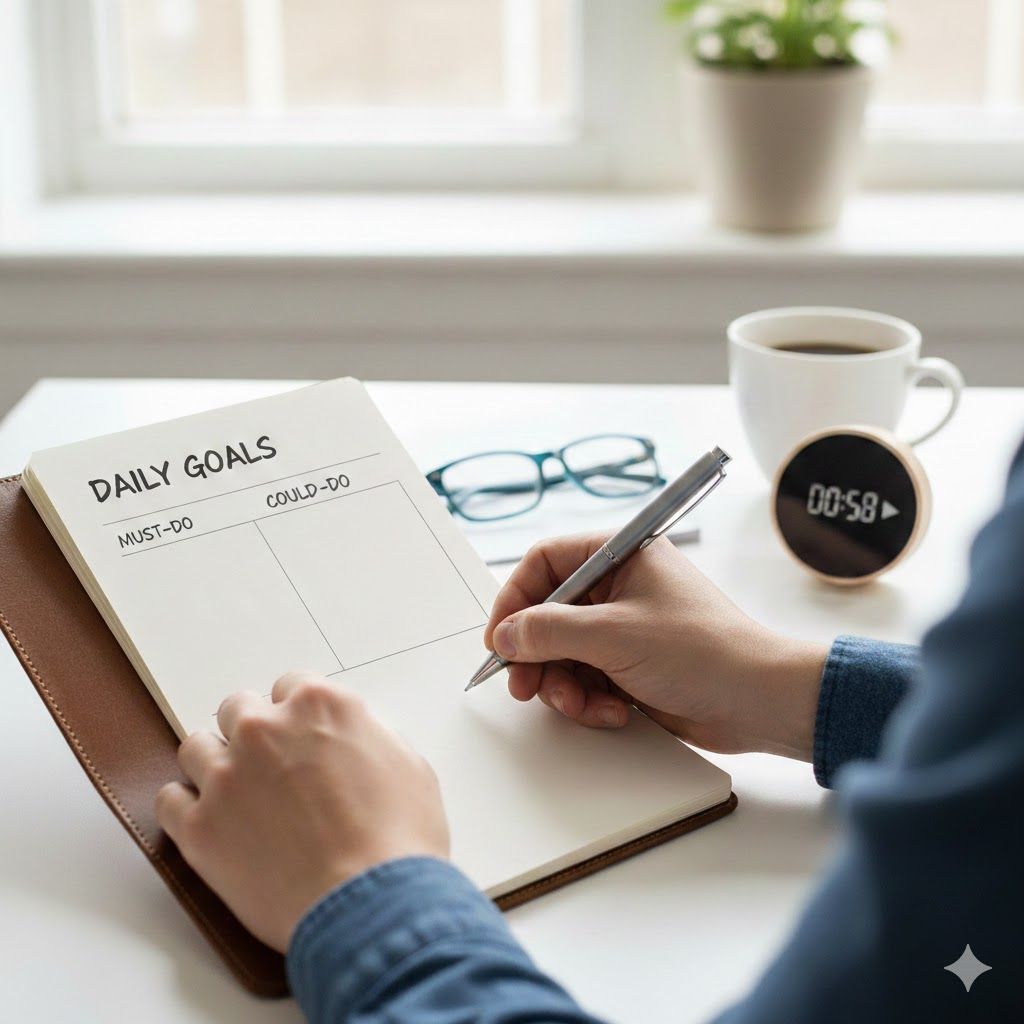
First of all, choose one demanding task you do regularly and move it to the optimum slot for when you are most focused.
- Pick a time to take Dr Breus’s Original Chronotype Quiz
Use your chronotype as a starting point and set aside a 60-minute slot:
- Lion. Try the first hour of your working day, when you tend to feel sharpest.
- Bear. Choose one hour between 10 am and 2 pm, the window Breus suggests. Start at 10 am if your focus normally dips after lunch.
- Wolf. Select an hour mid to late afternoon if you feel more alert later in the day.
- Dolphin. If your alertness varies after a restless night, compare shorter blocks at different times to see what works for you.
2. Give the task a clear goal. A measurable and focused goal for that hour. Be sure to turn off all notifications to stop distractions.
3. Move routine tasks around it. Save routine tasks for a time when your energy tends to dip. If your diary is packed, choose a slot between other commitments.
4. See what changes. Try the new slot for two weeks for this particular task. Notice how easy it is to get started, how much you get done and how much is left to go.
Part Two: Stephanie Romiszewski ‘Think Less, Sleep More’
“When you start seeing your days as the foundation of your night, everything shifts.”
Stephanie Romiszewski
Can Your Chronotype Change?
In her 2026 book, ‘Think Less, Sleep More’, British sleep physiologist Stephanie Romiszewski asks how much of your night owl or morning lark chronotype comes from biology and how much from your routine. You may prefer late nights but still find that a different routine can be achieved, depending on when you feel sleepy or alert.
Romiszewski believes that our chronotype is not fixed. She affirms that it is partly from our genes, but also from our habits and lifestyle.
“Chronotype is real, but it’s not fixed. It’s shaped not only by your genes, but by your light exposure, your habits, your social obligations and your mindset.”
Source: Romiszewski, 2026
James, The University Lecturer, Night Owl
In her book, Romiszewski gives the example of James, a university lecturer who believed his brain only switched on late at night. James got up at 6.30 am for work and believed that his weekend lie-ins and bursts of evening energy were evidence that he was a night owl.
However, when James settled into a steadier routine, he began to feel more alert earlier.
When they worked to improve his sleep baseline, something changed. James’ energy started coming earlier in the day. James realised this,
“I think I’ve been lying to myself for years,’ he told me, half-laughing, half-shocked. ‘Turns out I might not be a night owl. I was just inconsistent.”
Source: Think Less, Sleep More, Page 41
Can Night Owls Shift Their Body Clocks?
A randomised controlled trial in 2019 showed significant results: participants shifted their sleep and wake times about two hours earlier after changing several habits together.
As a result, this altered when they got morning light, ate their meals, exercised, and made other adjustments. Interestingly, clinical studies showed that their melatonin timing shifted too, showing that their body clocks had indeed moved.
Build a Consistent Sleep Baseline
Achieving a consistent sleep baseline will help you improve your health, life and work. This is the core message of ‘Think Less, Sleep More’.
A sleep baseline is a steady pattern you can use to see how you feel. Romiszewski indicates that a consistent wake-up time is more important than a strict bedtime. In fact, she recommends going to bed when you feel tired rather than a fixed wind-down routine at a certain time.
Getting up early one day and several hours later the next will make it difficult to ascertain when you are at your sleepiest and when you are at your most focused.
She advises that a steady sleep baseline with a routine wake-up time and enough time for sleep will allow you to identify the times when you are sleepy and alert to plan your work routine accordingly.
Why the Morning Matters
Romiszewski affirms that your sleep routine starts before bedtime. If you want to sleep earlier at night, a regular wake-up time and daylight early in your day give your body clock a consistent cue.
She suggests stepping outside within 30 to 60 minutes after waking up, as this will positively affect your circadian rhythm. In contrast, she says that going to bed early when you’re wide awake can leave you lying there watching the clock.
Sleep Trackers, Lie-ins and Catch-up Sleep
Stephanie explains that a sleep tracker on your smartwatch or phone can help you spot patterns, but chasing a better score may make sleep harder and increase sleep anxiety.
Likewise, a Sunday lie-in can make it harder to fall asleep that evening. If you often need catch-up sleep at weekends, check whether you’re getting enough sleep during the week. It is a consistent sleep baseline which is important. She recommends getting up around the same time each day rather than regular lie-ins.
Five Ways to Improve Your Sleep
Here is a summary of Stephanie’s advice in her book:
- Keep a steady wake-up time. Choose a time you can stick to most days, including weekends. If you’re getting up earlier, make sure you still have time for enough sleep.
- Get outside soon after waking. A short walk gives you daylight and a chance to move. This is positive for your circadian rhythm.
- Eat at regular times. Try to have your meals at roughly the same times each day.
- Wind down and wait until you feel sleepy. Give yourself some quiet time and go to bed when you feel ready to sleep.
- Look at how you sleep over several days. If checking the clock or your sleep score on your smartwatch or phone makes you anxious, stop doing it.
I heartily recommend reading ‘Think Less, Sleep More’. It is one of the best books on sleep that I have read in the last 10 years. It has changed my perspective greatly.
Summary
“When sleep drive and circadian rhythm are aligned, sleep feels effortless. You get tired at night, fall asleep quickly and wake up ready to be awake. But when they’re out of sync – because of artificial light, shift work, jet lag or bad sleep habits – sleep can feel impossible, even if you feel exhausted, or, if you can achieve it, it is light and broken.”
Source: Stephanie Romiszewski,
Think Less, Sleep More, p. 25.
Researching this article made me question how much of my late-night routine comes from my body clock and how much comes from habit. Your chronotype can help explain when you feel sharpest, and changing your routine may shift that timing. But before you write off your mornings, see what changes in your life when you give yourself enough time to sleep.
Key Takeaways
- Chronotypes change as you grow older: we may start as a lion as a baby and work through the other 3 types.
- Your habits are a major contributor; Romiszewski affirms that chronotypes are not fixed.
- Your sleep habits can change. You can train your body to follow a different schedule.
- Consistency matters. Getting up at the same time each morning helps reset your body clock and set a sleep baseline.
- Morning daylight is powerful. It signals to your brain that the day has begun and affects your sleep that night.
- Your behaviour influences your sleep. Light exposure, routines and activity can reinforce or change your sleeping patterns.
- Stop labelling yourself. Believing that you are one particular chronotype can discourage you from changing habits that are keeping you awake late at night.
Do you need Data Centre colocation services for your company or organisation? Fill out the Contact Form below. Let's talk about your hosting and server needs.
With IP House London as your partner, you will definitely sleep better at night!
FAQs
Can a night owl become an early bird?
Some late sleepers can shift their body clocks earlier. How far they can shift varies.
Is chronotype genetic?
Partly. Research has linked many genetic variants with a preference for earlier or later sleep.
Who coined the term ‘chronotype’?
C. F. Ehret coined
chronotype in 1974 to describe an organism’s natural tendency to sleep and wake at certain times.
Who popularised chronotypes?
Dr Michael Breus helped popularise chronotypes with his 2016 book
The Power of When. His model uses four animal profiles: lion, bear, wolf and dolphin.
Who coined the term ‘chronoworking’?
Journalist Ellen C. Scott coined the term in January 2024.
Can you chronowork on fixed hours?
Yes, if you have some say over the order of your tasks. Try doing your most demanding work when you usually concentrate best.
If you enjoyed this article, check out our article on Time Management.
Sources
Books and interviews
- Breus, M. (2016). The Power of When.
- Breus, M. How to Sleep Better by Knowing Your Chronotype. YouTube.
- Romiszewski, S. (2026). Think Less, Sleep More. Closing quote on p. 25 and James’s example on p. 41.
Sleep and chronotype research
- Baron, K. G. et al. (2017). ‘Orthosomnia: Are Some Patients Taking the Quantified Self Too Far?’. Journal of Clinical Sleep Medicine.
- Facer-Childs, E. R., Boiling, S. and Balanos, G. M. (2018). ‘The Effects of Time of Day and Chronotype on Cognitive and Physical Performance in Healthy Volunteers’. Sports Medicine - Open.
- Facer-Childs, E. R. et al. (2019). ‘Resetting the Late Timing of “Night Owls” Has a Positive Impact on Mental Health and Performance’. Sleep Medicine.
- Horne, J. A. and Östberg, O. (1976). ‘A Self-Assessment Questionnaire to Determine Morningness-Eveningness in Human Circadian Rhythms’. International Journal of Chronobiology.
- Jones, S. E. et al. (2019). ‘Genome-Wide Association Analyses of Chronotype in 697,828 Individuals Provides Insights into Circadian Rhythms’. Nature Communications.
- Roenneberg, T., Wirz-Justice, A. and Merrow, M. (2003). ‘Life Between Clocks: Daily Temporal Patterns of Human Chronotypes’. Journal of Biological Rhythms.
- The Physiological Society. ‘A Chronology of Chronobiology’.
Chronoworking, quizzes and guides
- Scott, E. C. (2024). ‘How to Start Chronoworking’. Working on Purpose.
- Parkinson, C. N. (1955). ‘Parkinson’s Law’. The Economist.
- Timeshifter. Morningness–Eveningness Questionnaire quiz.
- Sleep Doctor. Breus’s Chronotype Quiz and Bear Sleep Guide.
About the Author
Jamieson Lee Hill has been IP House’s Resident B2B Technology Writer since 2022, writing about data centre colocation across its core Gaming, EdTech and FinTech sectors. While not a data centre technician, his role is to research complex colocation and digital infrastructure topics and explain them clearly to non-technical readers.
A certified college lecturer and teacher with 27 years of experience, Jamieson holds a DMS in Business Management, a Certificate in Education and Cambridge DELTA, alongside 11 DigitalMarketer certifications, including SEO. He also undertakes professional development in cybersecurity, workplace AI, EEAT, AIO and AEO, and has certifications in video game design and storywriting.
Jamieson has run UK limited companies since 2012, and he has written educational books for RET International and Ixion College, including a 600+ page Diploma course book. He has also been editor for 3 books: The Adventures of Tom Sharpe books 1 and 2 by Peter Drinkwater and Life’s A Game by Mev Dinc.
A former teacher trainer and curriculum manager, he has designed courses for organisations including Sainsbury’s, Poundland, Swissport, Staffline and UK colleges. Since 2017, he has also taught and developed curricula for
More Than English Summer School in Business Studies, Global Leadership, Creative Writing and University Preparation.
Contact Us